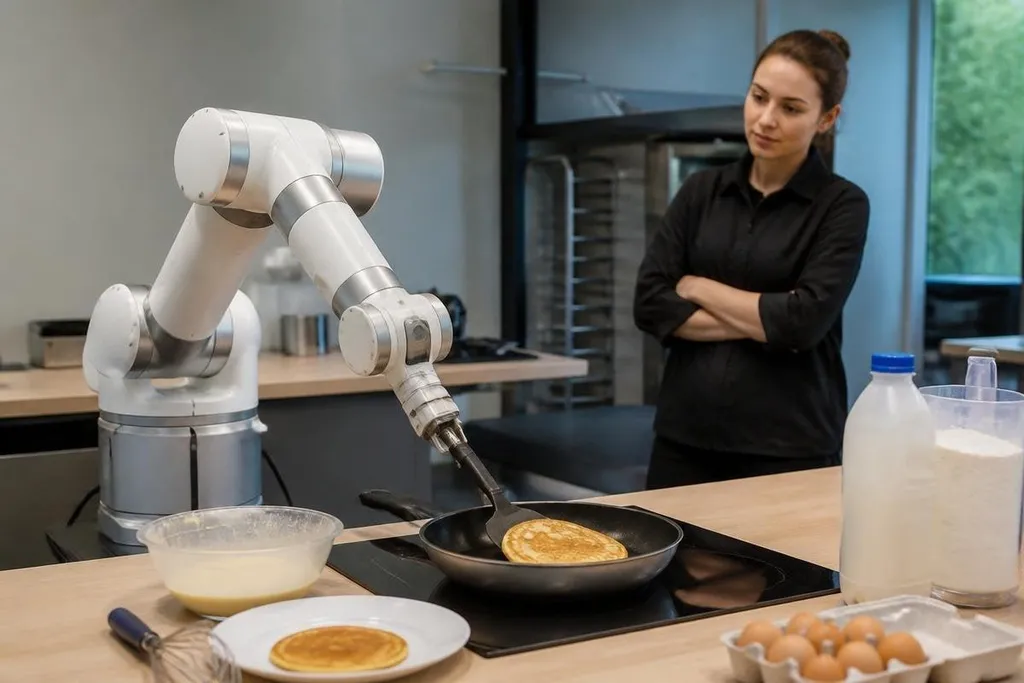
A robot that flips a pancake on camera has solved one motion. A useful cooking robot must also measure ingredients, control heat, move safely around a person, and leave the kitchen ready for the next meal. That gap explains why the race to build better cooking robots is harder than a short demo suggests.
- Heat changes the task: a robot must read pan temperature and adjust as food cooks.
- Hands need feedback: cameras alone may miss a soft tomato, a wet handle, or a loose lid.
- Cleanup sets the limit: a system that cooks well but needs a person after every step saves little time.
The kitchen is a hard robot workplace
A factory gives a robot fixed parts, known positions, and marked paths. A kitchen gives it flexible food, hot surfaces, spills, steam, and tools that move between tasks. It must deal with small changes without crushing food or dropping a pan.
That starts with sensing. Cameras can locate a bowl or read the position of a spoon, while force sensors can tell the robot how hard it is holding an object. Heat adds another problem: the robot needs a way to check a pan or oven without putting a sensor where it can melt or get dirty.
Cooking also has timing that cannot be reduced to arm movement. The robot may need to stir while a sauce thickens, lower heat when a pan gets too hot, then move a cooked item before it burns.
Each step depends on the one before it, so a mistake early in the recipe can change the rest of the meal.
The useful robot will handle a narrow job well
A full kitchen robot sounds attractive, but a narrow system has a clearer path to useful work. A robot that loads a dishwasher, moves ingredients, or stirs a pot can be tested against one task with a known result.
The test should count more than successful plates. It should record dropped food, broken ingredients, safety stops, cleaning time, and the number of times a person must take over. A machine that finishes a meal but needs ten minutes of hand correction has a different value from one that works without help.
A cooking claim needs the robot, task, kitchen setup, and human handoffs named in the report. Cooking robot reporting from Robot24.com gives you a place to check those details before comparing an induction hob with a gas burner, air fryer, or oven.
A useful report should also name the cooking setup. An induction hob, gas burner, air fryer, and oven each create different sensing and safety needs. Without that detail, “cooking robot” can describe a fixed appliance as easily as a mobile arm.
Safety comes before menu size
Heat and sharp tools make kitchen automation different from many indoor robot tasks. The system needs a clear stop method, a safe distance from people, and a way to know when a tool or pan has moved out of its expected position.
Recovery matters too. A lid may not sit flat. A spoon may fall into a bowl. A person may reach across the work area. Good recovery means stopping, reporting the problem, and waiting for a safe instruction rather than guessing.
Privacy matters too. A kitchen robot may need cameras aimed at food preparation for long periods. Buyers should ask where those images go, how long they stay there, and whether the system can work with local processing.
What buyers should ask before paying
The competition will produce many demos. Your decision should rest on repeatable work in the kitchen you actually have.
- Name the task: does the robot cook, serve, load, clean, or handle only one step?
- Check the setup: which hob, oven, tools, counter height, and bowl sizes does it support?
- Count human help: how often must someone guide the arm or fix a failed step?
- Measure cleanup: who washes the pan, wipes spills, and puts tools away?
- Read the safety plan: find the stop control, camera limits, and rules for people nearby.
- Ask about cost: include installation, service, replacement parts, and the time needed to learn the system.
The next proof point
I’d judge a cooking robot by a week of repeatable meals, not by its best recorded plate. That test would expose whether the system saves work or moves the work into supervision and cleanup.
The winning design may not cook every recipe. It may handle one part of dinner safely, repeat it without constant help, and fit the tools already in the kitchen. Until companies publish task results, failure rates, and the work left for people, the race remains a series of promising demonstrations rather than a buying decision.